Crying readers: an emotional twist to your Narrative

What Makes A Good Narrative Compelling And Believable?
That’s the main question every writer and narrative designer is concerned about while developing their narrative. From the Hero’s Journey to the Three Act Structure, we all seek methods to make our fictional characters more realistic.
Like myself, many authors have learned to rely on these tools to stand out. In this publishing rush, we might forget the main reason why we read and create stories: emotion.
Now, I’m not talking about always bringing tears to the reader’s eyes, but instead use emotions as a way to increase your character (and story) liveness and engagement. Picture for a second a whole day where you interact with people, and no one has any kind of emotional reaction. No smiles, fake surprised looks, frowns, laughs. Does this seem like a day you would want to remember?
Our audience is always looking for something to connect and resonate with their core values and struggles, and emotion is a big highway of human connections. Characters that make us laugh and feel are going to be much more memorable and much more likable than a blend robot spewing catchphrases and neutral dialogues. People are constantly trying to look at objects and searching for some hidden reaction, some resemblance of a humanlike behavior staring back at them.
But how do we get our plain old robotic characters into something unique using emotions? Well, first we have to do a little research into what emotions are and what are the prevailing theories for how (and when) we use them.
What is the deal of emotion (and what it has to do with Narrative)
What exactly are emotions? How many are there?
These and other similar questions have been asked by researchers from the most uncanny backgrounds; from psychologists and philosophers to game designers and data scientists. For this article’s sake, let’s just say that emotions are reactions to internal and external stimuli. They are a set of physical and psychological temporary responses to these events. To put it simply, every time you think about something, your current and past experiences may give birth to a different emotion; if you love climbing and see a huge mountain, you might feel happy about climbing it; not so much if you had a terrible accident trying to do something similar.
For scholars and nerds in general (like myself), this definition goes along with the appraisal view of emotions. That means the act of “feeling” something first goes through an internal evaluation (or appraisal); there are many models created for explaining this evaluation and the results we can use in our characters (their emotions). Generally speaking, they follow a set of pillars that a certain person takes into account when expressing/feeling a particular emotion.
The pillars of an emotional appraisal
In particular, let’s talk about one model created by a philosopher, a psychologist, and an accountant. It is not a joke! It’s the OCC model of emotions, and it is very useful to add emotional reactions to characters in a narrative.
The OCC model
Named after their creators Ortony, Clore, and Collins, this framework gives a very straightforward way to think about emotional feelings for a particular character. In short, it separates each emotion as the outcome of three types of evaluation: one focused on events occurred, the other on actions taken, and the third focused on objects in general. Every evaluation can have positive or negative outcomes from the character’s perspective. Each one has special considerations from the character perspective: actions can be done by the character itself, or a third-party; the events can have prospective (future/imagined) consequences, or can cause an immediate consequence in the present; and finally, the character can be familiarized or not with objects in general (foods, cars, money, etc).
If it sounds a little too complex, it’s because it is! Emotional responses are a very confusing and complex topic. Fortunately, we can sum up the OCC model in a neat diagram, comprised of 22 emotional reactions to the evaluations above.
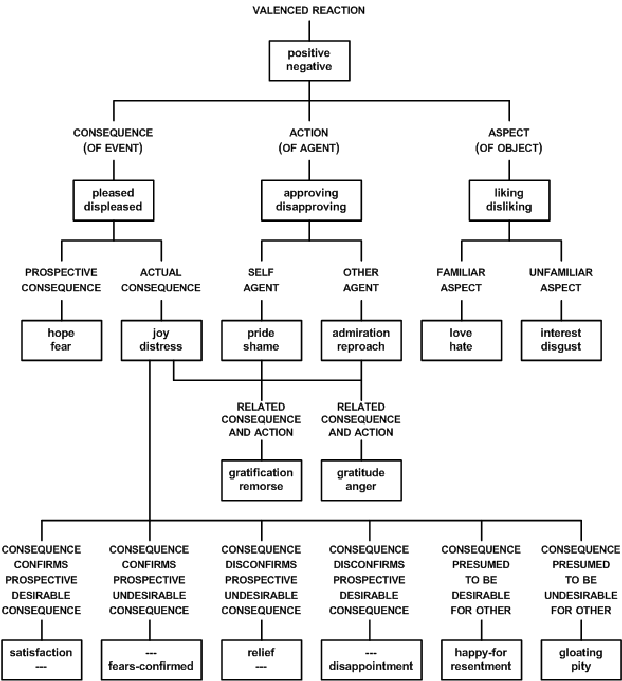
Translating the OCC diagram into character behavior
Let’s take this unfriendly diagram and break it into actionable emotions for narrative development. Let’s we are following the story of Luke, a stockbroker who is about to lose his career; to properly capture Luke’s emotion, we will explore two different narrative perspectives:
The last perspective is where things with OCC get interesting: we can make Luke a completely different person just by changing his emotional reactions. Instead of feeling ashamed, he can actually feel proud of his boldness, firmly believing that the market will recover and give him tons of money. He can also feel anger at the client for not seeing things the way he is. By doing this change, we just followed the same branches in the OCC and changed their meaning from negative to positive.
We can create further emotional reactions by taking into account his boss’s behavior, whether he knows about the loss or not, and so on. The beauty of the OCC diagram is that it can be as complex as you want your characters to be.
How to use emotion to create unforgettable characters (Emotional Narrative)
Based on the OCC model of emotions, and the 4 pillars of emotional appraisal, we can give our characters more depth and add some realism to their reactions.
Define the character outline: Who is this character? what does he contribute to the narrative? How does he look?
Start to think about his emotional depth: Define the character main Goals, Standards, and Tastes, in that order. This will give a foundation on how to act and behave in different situations. If you want more depth, go for past experiences as well.
Find their main emotions felt along with the narrative: Take a particular plot event and consider its emotional consequences for the character. How will it affect his behavior? Was he expecting this event? Does this event have consequences? If so, did they happen or are they still in the future?
Based on these questions, consider also the pillars defined in step two and follow along with the OCC diagram.
Go off-script: After all, if there is one thing we can all agree on is that people do not behave in a linear and neat way. Feel free to toss all emotional reactions from the previous steps aside every once in a while. This gives your readers a more surprising turn of events, and make your character even more human.
Are emotions that predictable?
Of course not! This is simply one framework based on solid science that can help you create realistic characters in your next narrative. There are many others out there, including different views of how to model emotions; if we are talking faces, there is for example the famous work of Paul Eckman, who mapped 6 universal emotions that we feel, regardless of our cultural background.
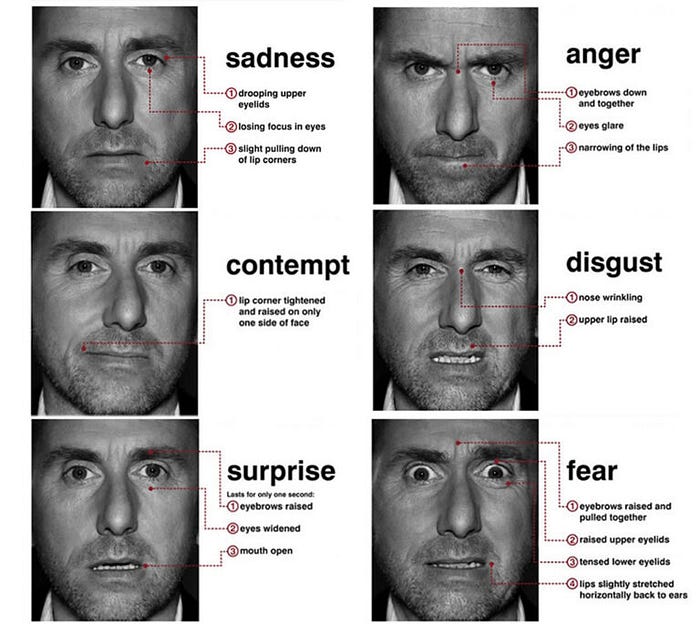
Even though this framework is very useful, it can become very complex fast. So keep in mind to use it only for main plot events, as well as for main characters along with the story. Once you are comfortable using this new approach, you can spice things up by adding personality traits and narrative archetypes.
Good luck with your next emotional narrative!
References
Steunebrink, Bas & Dastani, Mehdi & Ch, John-Jules & Meyer, John-jules. (2009). The OCC model revisited.

About Gabriel Natucci
Related Articles

Narrative, plot, Story: what is the difference?
Explore the key differences between narrative, plot, and story to enhance your writing and game design skills effectively.

What is LitRPG and why you should start reading it
Discover LitRPG: a captivating genre blending RPG elements with fiction, perfect for fantasy fans seeking immersive narratives.

How I Learned to Live Again
Explore how to find meaning in life, overcoming success-induced misery, and embracing personal growth through experiences and storytelling.